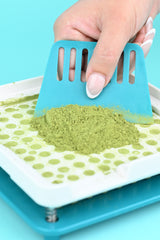
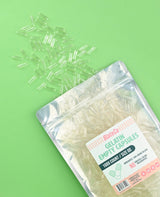
A manual capsule filler is a simple device that lets you fill empty capsules with powdered supplements at home. Instead of buying pre-filled capsules from a brand that decides the formula for you, you work directly with the powder you choose. A typical manual capsule filling machine holds 24, 100, or 400 empty capsules at once, aligns the capsule tops and the capsule bottoms, and helps you evenly distribute and pack powder before sealing them back together. It is straightforward, mechanical, and surprisingly efficient once you get the rhythm down.
Good setups include a frame plate that goes on top of the capsule-filling tray to align the capsule bodies upright, allowing them to be filled evenly. You spread your powder across the surface, use a card or spreader to guide it into each capsule, and lightly tamp it down if needed. After filling, you place the capsule tops back on and press to lock them. A capsule filler tray keeps everything aligned, so you are not filling capsules one by one. For a detailed walkthrough of the full process, we put together a piece on how to use your capsule filler core series to show exactly how it works step by step.
Note: Common 24-hole capsule machines do not have a frame plate and require the user to manually insert each capsule body and top half one by one. Other machines, mainly those that fill less than 100 at a time, don’t come with a capping tray either… so you’ll have to put the capsule top half onto each bottom half one by one as well. Blated machines all come with these integral parts to make the entire process fast and simple.
The appeal of a manual capsule filler is control. You choose the powder source, the dosage, and the capsule type. You are not relying on a label that may include fillers, binders, or anti-caking agents you did not ask for. It does take a little practice, but once you understand how a manual capsule-filling machine works, it becomes a practical part of a weekly routine for anyone working with bulk powders.
Why So Many People Are Turning To DIY Capsules
There has been a noticeable shift in how people approach supplements. Instead of passively buying whatever is on the shelf, many are asking harder questions about ingredients, sourcing, and long-term cost. That curiosity is leading more people to make their own capsules at home for a few key reasons:
Questioning Hidden Ingredients
If you have ever flipped over a supplement bottle and struggled to pronounce half the inactive ingredients, you are not alone. Many store-bought capsules include artificial colors, anti-caking agents, binders, and preservatives that make manufacturing easier but add nothing nutritionally. For people already purchasing bulk powders like mushrooms, kratom, greens, or amino acids, using a manual capsule filler removes those unnecessary extras and keeps the formula simple.
Reducing Long-Term Costs
Pre-filled capsules often contain less active ingredients than expected, and part of what you pay for goes toward branding, packaging, and distribution. When you use a capsule filling tray at home, you buy powder in bulk and portion it yourself as needed. Over time, the savings can be significant, especially for anyone supplementing daily with larger doses.
Gaining Transparency And Control
There is something grounding about seeing exactly what goes into your capsules. A manual capsule-filling machine, or even a simple pill-filler tray, makes the process visible and hands-on. You measure the powder, fill the capsules, and seal them yourself, which changes supplementation from a passive purchase into an intentional routine.
What’s Actually Inside Store-Bought Supplements?
Most people assume that if a supplement is on a store shelf, it has been carefully formulated with their health as the top priority. The reality is often more complicated and far less transparent. If you start reading labels closely, a few patterns begin to stand out:
Fillers And Flow Agents
Many capsules contain ingredients that are not there for your benefit, but for manufacturing efficiency. Magnesium stearate, silicon dioxide, artificial colors, and other flow agents help machines run smoothly and extend shelf life. Others may be commonly used and generally regarded as safe, but they also dilute what you are actually paying for. When you use a capsule filler tray at home, you decide what goes into each capsule.
Private Label Manufacturing
It surprises many people to learn how easy it is to launch a supplement brand. A company can source bulk powder, send it to a contract manufacturer, choose a capsule size, add a label, and start selling. The person creating the brand does not need advanced training in nutrition or formulation. Using a manual capsule-filling machine at home gives you more insight into what formulation really entails, because you are the one weighing and assembling the ingredients.
Cost Markup Versus Active Ingredient
Pre-filled capsules often carry a steep markup compared to the cost of bulk powder. You are paying for branding, distribution, retail placement, and marketing campaigns. With a pill-filler tray or a full manual capsule-filler setup, the majority of your cost goes toward the actual ingredient. For many people, that shift alone is reason enough to rethink how they supplement.
How To Choose The Right Manual Capsule Filling Machine Or Tray
Once you decide to make your own capsules, the next question is which setup makes sense for you. There are several styles available, and the right choice depends on how often you plan to fill capsules and how much powder you typically work with. A little planning up front can save you frustration later:
Understanding Capsule Sizes
Capsules come in different sizes, commonly ranging from 000 down to 3 or smaller. Larger capsules hold more powder, but they can also be harder for some people to swallow. Before choosing a capsule filling tray, it helps to estimate how much of your specific powder fits into each size. Our Capsule Size Calculator walks you through that process so you can match your dosage goals to the right capsule size.
Tray Versus Full Manual Capsule Filler
A basic capsule filler tray like those that do less than 100 capsules at a time are compact and great for smaller batches. It aligns capsule bodies so you can fill multiple at once without working one by one. A full manual capsule-filling machine (like the Blated Core Series models) include additional plates such as the frame and capping plates, making it easier to produce larger quantities consistently. If you supplement daily or prepare capsules for a week at a time, a structured manual capsule filler setup can make the process smoother and more repeatable.
Build Quality And Cleanability
Not all machines are built the same. Materials matter, especially when you are working with powders you intend to consume. Look for designs with clean, simple ingredient contact surfaces and parts that can be easily taken apart for washing. A well-designed pill-filler tray or machine should feel sturdy, precisely align capsules, and be easy to maintain without complicated tools.
How To Get Accurate Dosages When Filling Capsules At Home
One of the biggest concerns people have about making their own capsules is dosage accuracy. It is a fair question. If you are moving away from pre-measured store-bought products, you want to know that what you are filling is consistent and aligned with your intended serving size:
Start With The Right Tools
A digital scale is essential for working with powdered supplements. Volume alone is not reliable because different powders have different densities. When using a manual capsule filling machine, weighing your powder before filling helps you understand how much total material you are working with and how it will distribute across each capsule. This step turns a capsule filling tray from a simple organizer into a precision tool.
Match Capsule Size To Desired Serving
The amount each capsule holds depends on both the capsule size and the density of your powder. A pill filler tray can only hold what physically fits into the capsule body, so choosing the correct size is essential for accurate dosing. For a deeper breakdown of the math and process, we explain it step by step in our article on how to fill capsules with exact dosages, including how to adjust if your powder is lighter or denser than expected.
Work In Batches And Verify
When using a manual capsule filler, it helps to think in terms of density. You’ll always be filling your capsules completely so they are packed as tightly as possible. By doing this, you ensure each capsule holds the same amount as the one next to it. A digital scale and our capsule calculator or formulation tool will help you be sure you’re doing it correctly. For those just starting out, our Beginner's Guide to Filling Your Own Capsules walks through the full process from measuring to sealing so you can build consistency into your routine.
Is A Manual Capsule Filler Worth It? A Cost Breakdown
For many people, the decision comes down to math. Bulk powders are typically far less expensive per gram than pre-filled capsules, even when sourced from reputable suppliers. When you use a manual capsule filler at home, most of what you are paying for is the actual ingredient, not the bottle, branding, or retail markup layered on top.
There is also the long-term value of the equipment itself. A quality manual capsule filling machine can be used repeatedly for years, spreading its cost across hundreds or even thousands of capsules. Even a simple capsule filler tray or pill filler tray can quickly pay for itself if you supplement consistently. The more frequently you fill capsules, the more noticeable the savings become.
Beyond cost, there is the value of control. You choose the powder, the capsule type, and the serving size based on your needs and conversations with your healthcare provider. For many people, the ownership of the process makes a manual capsule filler worth it long before the financial savings fully materialize.
And with how often supplement companies have been shown to contain ingredients not on the label, or to have much less than what is promised, making capsules yourself starts to look like the only safe option! (Wang et al., 2023)
Sources:
- Wang, Y., Neilson, L. C., & Ji, S. (2023). Why and how do consumers use dietary supplements? A systematic review and thematic analysis. Health Promotion International, 38(1), daac197. https://doi.org/10.1093/heapro/daac197
- Zhang, F. F., Barr, S. I., McNulty, H., Li, D., & Blumberg, J. B. (2020). Health effects of vitamin and mineral supplements. BMJ, 369, m2511. https://doi.org/10.1136/bmj.m2511
- National Center for Complementary and Integrative Health. (2019, January). Using Dietary Supplements Wisely. NCCIH. https://www.nccih.nih.gov/health/using-dietary-supplements-wisely
- National Institutes of Health. (2023, January 4). Office of Dietary Supplements - Dietary Supplements: What You Need to Know. Ods.od.nih.gov. https://ods.od.nih.gov/factsheets/WYNTK-Consumer/
- Cohen, P. A., Avula, B., Katragunta, K., Travis, J. C., & Khan, I. (2023). Presence and Quantity of Botanical Ingredients With Purported Performance-Enhancing Properties in Sports Supplements. JAMA Network Open, 6(7), e2323879. https://doi.org/10.1001/jamanetworkopen.2023.23879