On the surface, capsules and tablets appear to do the same job. They're both small, swallowable, and sold next to each other on the same shelf. But the way they're made couldn't be more different, and that distinction matters more than most people realize.
A tablet is a compressed brick. Manufacturers take powdered ingredients and press them together under high pressure, almost always with the help of binders, fillers, and coatings to hold the shape and prevent crumbling. Think of it like a pressed powder compact. It holds together because something is forcing it to. A capsule works differently. It's a two-piece shell, usually made from gelatin or a plant-based alternative, that holds powdered ingredients inside. Nothing needs to be pressed or bound. The shell provides the container, and the ingredient remains in its natural powdered form.
That difference in construction is exactly why the two formats behave differently in your body, and why the ingredient list on a tablet tends to run longer than you'd expect for something marketed as a single supplement. Those extra ingredients aren't accidental. They're structural requirements, and they come along for the ride whether you want them to or not.
Pill vs Capsule Absorption: What Happens After You Swallow
The form your supplement comes in affects more than just how easy it is to swallow. It shapes how quickly your body can access the active ingredient, how much of it actually gets absorbed, and what else gets absorbed along with it. Here's how capsules and tablets compare at each stage of the process:
Tablets Have To Be Broken Down First
Tablets are compressed with binders and coatings that your digestive system has to break down before the active ingredient is released. That breakdown process can be slow and inconsistent depending on the binders and coatings used. Some heavily coated tablets pass through without fully dissolving, meaning your body may not fully access what you paid for. That breakdown process can be slow and inconsistent. Some heavily coated tablets pass through without fully dissolving, meaning your body may not fully access what you paid for.
How Dissolution Actually Works
Capsule shells dissolve in the stomach once exposed to moisture and digestive acids, typically releasing powder within around 15 minutes or longer depending on the capsule material, thickness, and manufacturing. Tablets vary far more widely. Some uncoated tablets dissolve almost immediately on contact with water. Others, particularly those with enteric or film coatings, take considerably longer. The notion that capsules are always faster than tablets is not accurate — dissolution speed depends on how a specific product is formulated, what coatings or binders are used, and whether time-release components are involved. Format is a factor, but it is not the deciding one.
What's Inside Still Matters Most
Absorption is not only about the delivery format. A capsule filled with low-quality powder or poor bioavailability ingredients will not automatically outperform a well-formulated tablet. The format gives you a head start, but the source and quality of your ingredient carries the most weight in the long run. That's a conversation worth having separately, and it's exactly where capsule material and shell quality come into play.
When Tablets Have The Edge
Tablets get a bad reputation in DIY supplement circles, but dismissing them entirely wouldn't be accurate or fair. There are legitimate reasons they've been around for over a century, and real situations where they outperform capsules. Here's where tablets genuinely hold their own:
Tablets Offer Better Long-Term Stability
Tablet stability varies significantly depending on formulation, coating type, and storage conditions. Some coatings do offer meaningful protection against moisture and air, which can be an advantage for sensitive compounds. However, certain tablet formulations are hygroscopic and can absorb moisture and degrade faster than a well-stored capsule. Stability is less about the format and more about how a specific product is made and how it is kept.
Some Ingredients Are Simply Better Suited To Tablets
Effervescent tablets are designed to dissolve in water and serve a completely different delivery purpose than a capsule ever could. Sublingual tablets, meant to dissolve under the tongue for faster uptake, also fall into this category. These are formats built around specific ingredient behaviors, not just convenience.
Tablets Can Deliver Consistent Dosing At Scale
At a manufacturing level, tablet pressing is a highly controlled process. Each compressed tablet contains a precise, consistent amount of ingredient across millions of units. For pharmaceutical-grade production where exact uniformity is critical, this level of dosing consistency is difficult to match through other methods.
Are Capsules Better Than Tablets For Most People?
For the average person building a daily supplement routine, the format question comes down to a few practical realities: what you're taking, why you're taking it, and what else comes along for the ride. Here's where capsules tend to pull ahead for everyday use:
Capsules Carry Fewer Unnecessary Ingredients
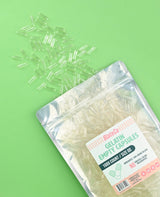
A two-piece capsule shell made from gelatin typically contains just gelatin and water, while pullulan capsules — the kind Blated carries — are produced from a single naturally occurring ingredient with nothing added. That simplicity is the point. There is no structural requirement forcing extra materials into the formula, which means the only thing inside your capsule is what you deliberately chose to put there. That simplicity is the point. There is no structural requirement forcing extra materials into the formula, which means the only thing inside your capsule is what you deliberately chose to put there. For anyone trying to keep their supplement routine genuinely clean, that level of ingredient control is difficult to match in any other format.
Capsules Are Easier To Customize
With capsules, you control the dose, the ingredient, and the source. Our guide on How to Make Your Own Supplements walks through exactly how to put that control into practice. You're not locked into a manufacturer's formula or a fixed compression ratio. Whether you're working with greens, mushroom powder, BCAAs, or herbal powders, capsules adapt to your needs rather than requiring your needs to adapt to them.
Capsules Are Generally Easier To Swallow
Whether a capsule or tablet is easier to swallow depends primarily on size, not format. A small tablet can be easier to swallow than a large capsule, and vice versa. Smaller capsule sizes also give you flexibility in managing your intake without splitting or crushing anything.
Capsule Or Tablet Which Is Better: It Depends On What's Inside
Once you've landed on capsules as the right format for your routine, the next question is which capsule. The shell material is a decision most people skip entirely, trusting that one capsule is essentially the same as another. It isn't. For those curious about delivery formats beyond capsules, our resource on Everything About Edible Gel Films covers another clean option worth knowing. What the shell is made from affects what you're putting into your body just as much as the ingredient inside it, and most labels don't make that easy to see. Here's what to actually look for:
Gelatin Capsules Are The Most Widely Used
Gelatin capsules are made from gelatin and water — gelatin being a naturally occurring protein derived from animal collagen. They dissolve reliably, have a long track record of safe use, and carry no unnecessary additives. For non-vegetarian users, gelatin remains one of the cleanest and most straightforward capsule options available on the market today.
Pullulan Is The Genuinely Natural Vegan Option
Pullulan is a naturally occurring polysaccharide produced through fermentation of tapioca starch. At Blated, pullulan is the only vegan capsule material we carry because it meets a naturally derived standard that synthetic alternatives simply don't. If clean and plant-based supplementation matters to you, pullulan is worth knowing about.
HPMC Is Semi-Synthetic And Not Truly Vegan
HPMC, or hydroxypropyl methylcellulose, is commonly marketed as a vegan capsule material, but it is a semi-synthetic cellulose material — derived from natural cellulose but subject to significant chemical modification — not a naturally derived one. At Blated, we don't consider it a genuinely vegan option. Labeling a semi-synthetic material as vegan-friendly is misleading to consumers who are making ingredient decisions based on that claim.
Taking Control: Filling Your Own Capsules At Home
Understanding the difference between capsules and tablets is one thing. Actually doing something with that knowledge is another. Filling your own capsules at home puts the format decision entirely in your hands, and the process is more straightforward than most people expect. Our The Ultimate Guide to Making Your Own Supplements covers the full process from start to finish. Here's what to know before getting started:
You'll Need A Capsule Filling Machine
A capsule filling machine — sometimes searched online as a "pill filler" — is the tool that lets you load powdered ingredients into empty capsule shells quickly and consistently. It's worth clarifying that a pill press is technically a tablet press, a separate device that compresses powder into solid tablets. Most home users are looking for a capsule filler, which handles two-piece shell capsules instead.
Choosing The Right Capsule Size Matters
Capsule sizes range from large to small, and knowing which one fits your routine starts with understanding how much powder each can actually hold. Our guide on How to Pick the Best Capsule Size covers the full decision process. That figure varies with the density of your specific ingredient, so the same capsule size can hold very different amounts depending on what you are filling it with.
Blated's capsule size chart and calculator is the most reliable way to find accurate fill weights for your powder before committing to a size. Pairing that with a digital scale to confirm actual dosage after filling removes the remaining guesswork. Using general figures from outside sources is an easy way to end up with the wrong dose.
Loading Both Halves Takes A Little Practice
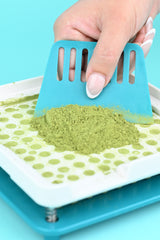
On manual capsule filling machines, both capsule halves are loaded into their respective trays separately — the body goes into the bottom tray where it will be filled with powder, and the cap sits in the top tray ready to close. Only the body is filled. The top tray is then pressed down to snap the caps onto the filled bodies. If the loading process feels tedious, Blated's Quick Flip Trick speeds things up considerably, and pre-separated capsules are also available to simplify loading from the start.